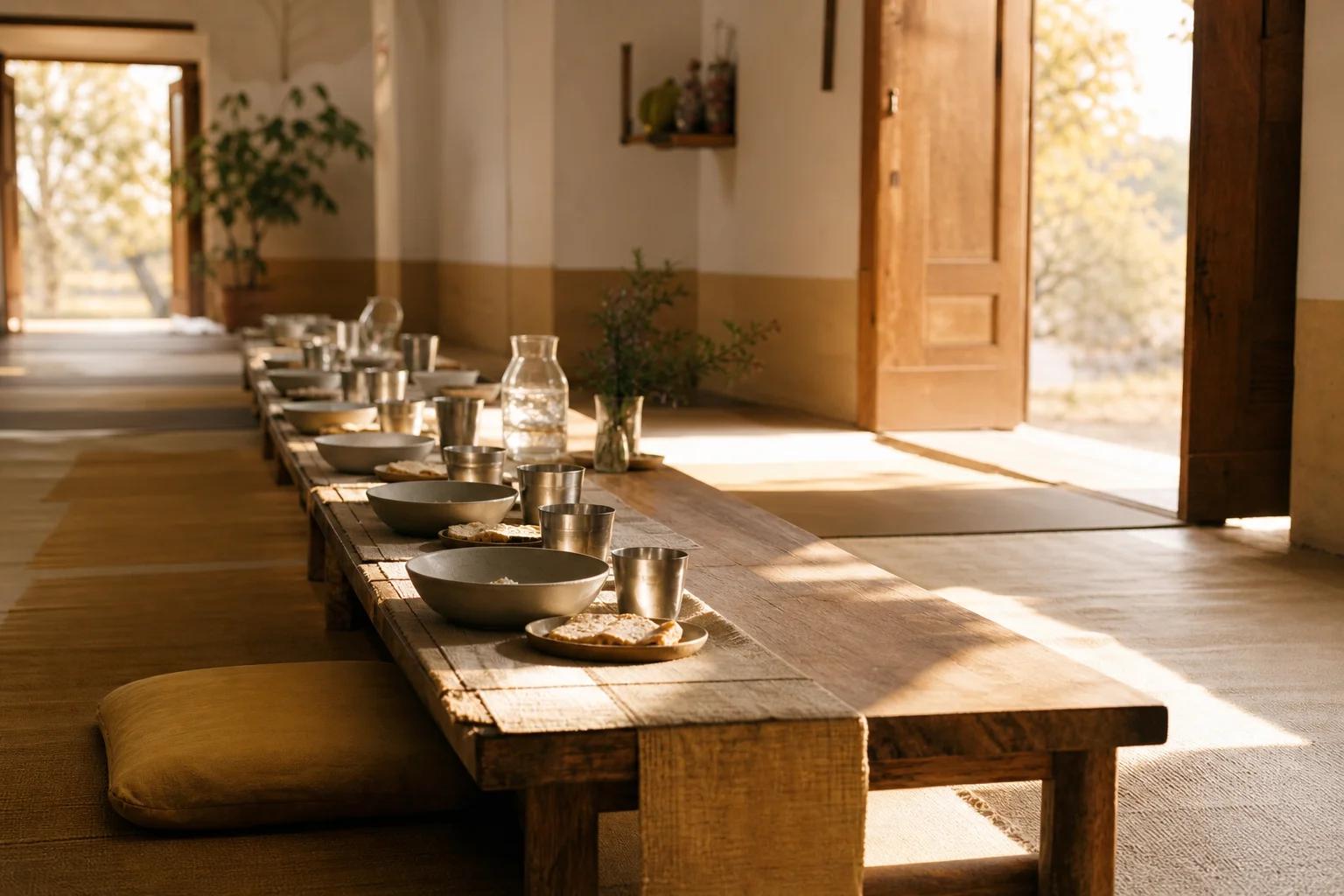
The Stranger at the Table: What Langar Teaches About Being Received

Most of us know what it is to be a guest. Fewer of us know what it is to be welcomed as a stranger, with no history, no explanation and no proof that we belong. We are simply received. That distinction sits at the heart of a piece of seasonal writing worth slowing down for.
A tradition that sets a wider table
As Americans prepare for Thanksgiving, an essay from The Conversation, carried by Religion News Service, turns to a centuries-old Sikh tradition for a broader picture of what hospitality can be. Its author, a scholar of Asian religions, sets the holiday's familiar circle of family and friends beside the Sikh practice of langar, which encourages welcome toward people we do not know.
For readers unfamiliar with it, langar is widely known as the shared community meal offered in Sikh gurdwaras, open to anyone who walks in. The gesture is simple: you are fed because you are here.
A smaller reflection from the same week echoes that spirit. In a lyric piece for Mindful, new contributor John Ptacek considers how modest kindnesses between strangers in public places reveal how much we long for connection, and how much compassion we can still offer when times are hard.
Why being received matters
There is a quiet difference between being included and being welcomed. Inclusion can come with conditions: the right introduction, the right story, the right version of ourselves. Welcome, at its best, asks for none of that.
Many people move through life carrying a sense that they must earn their place before they can rest in it. We tidy our feelings before sharing them. We rehearse explanations. We wait until we've worked out what is wrong before we let anyone near. Traditions like langar hold up another possibility, one where arriving is enough.
It is worth noticing which side of the table we tend to sit on. Some of us find it natural to offer welcome but hard to accept it. Others feel they are always the guest, never quite at home. Both positions can teach us something about how we relate to ourselves, because the way we treat the stranger often mirrors the way we treat the unfamiliar parts of our own inner life: the grief we haven't named, the change we didn't choose, the version of us we haven't met yet.
A few questions to sit with this season
- When did someone last welcome you without needing you to explain yourself?
- Is there a part of you that you only let in once it has "behaved"?
- What would it mean to set a wider table, even inwardly?
Being met without having to earn it
This is part of why one-to-one spiritual guidance can feel meaningful to people in moments of change. At Orykl, the intention is a private space where someone can arrive as they are, with nothing figured out in advance, and be met by one carefully vetted practitioner who is there to listen. It is not a fix or a diagnosis. It is closer to a seat at a table: an hour where attention is given freely, and where what surfaces can be gently looked at rather than hurried away.
Like the small kindnesses Ptacek describes, being heard by another person can be quietly profound. And like langar, it rests on a simple premise: you don't need to have earned the welcome to receive it. Afterwards, there is room to return to what came up and reflect at your own pace.
Sources
- Religion News Service: As Americans gather for Thanksgiving, a centuries-old Sikh tradition offers an expansive vision of hospitality
- Mindful: Kindness in Store
Making room at your own table
Thanksgiving invites us to gather the people we love. Langar invites us to imagine a table with no edges. Somewhere between the two is an invitation turned inward: to welcome the parts of ourselves that feel like strangers, and to let others welcome us, too.
If you've been waiting to have it all sorted before you let anyone in, perhaps this is your reminder that you can simply arrive. A conversation with a matched, carefully vetted spiritual practitioner can be one place to be received exactly as you are.

Match with spiritual practitioners.
You didn't lose yourself overnight. Book a 60-minute $75 session with a matched, carefully vetted practitioner to find your way back.
Related articles

What If You Aren't Lost, Just Still Being Built?
A philosopher questions whether there is a hidden core self waiting to be found. What if who we are is something we build, slowly, through where we place our attention?
Orykl Team · Oct 30, 2026
You Don't Have to Be Good at Meditation
You sit down to meditate, close your eyes, and try to focus on your breathing. Within seconds, you're thinking about what to make for dinner, a message you haven't answered,
Orykl Team · Oct 7, 2026

What Psychedelics Are Teaching Us About Healing
For decades, psychedelics were mostly discussed in one context: drugs. Illegal drugs, recreational drugs, dangerous drugs.
Orykl Team · Sep 9, 2026

Plant Medicine: Spiritual Meaning and Reflection
Plant medicine carries spiritual and ceremonial meaning for some people. The questions an experience raises can remain personal and open-ended.
Orykl Team · Dec 3, 2025